The first code for my game was written on 27th January 2024. As it was both my first time using Scala Native and Raylib1, it began as a simple proof of concept - all I did was to make a window appear, and write some text to that window:
Hello, World!
The next few weeks was a flurry of activity after work as I explored the basic mechanics of the game engine and extended them for my own ends; how to translate keyboard inputs into objects moving across the screen, collisions, moving between rooms, having the camera track the player. It started as grey blocks moving against a white background as I teased out the issues that would come pre-solved in a modern, batteries-included game engine. There was so much to do and the joy of figuring things out for myself was driving me forward - "let's add stairs!", "let's add scrolling text boxes!", "let's figure out interacting with the environment!". The grey blocks remained. It was spring and I had all the groundwork ready for my top-down 2D game, I was struck by the realisation that there was one giant leap that now needed to be taken to continue development. The grey blocks had to be replaced by colour and art, the stairs had to lead somewhere, and the text that scrolled couldn't just read "foo bar fuck shit". In short, the engineering had mostly finished, and now I needed to be an artist.
That moment of clarity stopped me dead in my tracks, and the project sat dormant for 9 months. I burnt out at work, quit my job, moved out of London and finished my other personal software projects, but that grey, blocky elephant lurked in the corner. There were nothing but uncharted waters ahead and no excuses left for not plucking up the courage and steering the ship out to sea.
Eventually I did manage to take that leap, and this post is a look at what it took for me to break the seal, and then some exposure therapy as I show a little of my progress in building out the pixel art for my game.
Unpacking the nerves
Since leaving school and its hour-per-fortnight of art classes, my experience with the visual arts has amounted to a handful of craft or watercolour evenings with friends, a pottery class, and sketching a man's bum at a hen party - all environments where the output is secondary to the social and experiential aspects of creation. Sometimes I would take a smidgeon of pride in producing something that I didn't think was totally shit, and occasionally elicit a coo of "ooh, that's nice!" from a fellow participant. But the jump from "a fun way to connect with friends" to sitting down on my own and trying to create anything that looked good was daunting. I do not imagine that this is a unique feeling, but this is my therapy session so I get to pretend that no-one else has had any coherent thoughts on the matter.
The crux of the matter is that art is subjective, and people's subjective opinions about me carry more weight than I would like to admit. This in concert with the fact that I might be bad at it (I mean God forbid anyone be bad at something with which they have not done before) was a mighty mental obstacle to overcome2. I may even practise, and to my own eye improve, but make something that everyone else thinks is rubbish.
There was a big part of me that craved a gauge by which I could create something and it would give me a reading of how well I had done. I have felt this pull often, but I am wary of the fact that a reliance on measurable performance has plagued, as well as pushed, me in many areas of my life. The line between it being a genuine and useful benchmark towards being a happier and better person and a crutch to lean my self-worth on has at times been pretty fuzzy. In a world of uncertainty and chaos and nuance, there is a quiet comfort in being able to point at a number and say "that is how I'm doing, and if it goes up, I'm doing better". Not to mention that there is just something inherently interesting in statistics. Conversely, getting caught up in the numbers can come with a detachment from experiencing reality - which (hot take) is mostly the point of being alive - and the simple truth that the value of a pursuit transcends the numbers you can attach to it.
You have been weighed, you have been measured, and you have been found wanting.
- A Knight's Tale
One of the most stark examples of facing this conflict was my relationship with academia. I always took academic achievement very seriously at school and university. However, in my early twenties, I realised3 that I was over-emphasising the role of academic success and having professors tell me I was doing a good job on how I perceived my value as a human. That ultimately helped me walk away from an ill-suited PhD place, which I consider one of the best decisions I have made in my adult life.
I have also seen this clash of ideals arise in my hobbies, where I have become more wary of stats and figures pulling focus away from enjoying the ride. On a recent trail run with my brother we got to talking about his Garmin watch - on the one hand4 it was so fun to track our ascent and watch it slowly tick up towards 500m, but on the other we acknowledged how focussing on the stats took something away from the simple joy of feeling our bodies working5. I am finding more and more happiness from not having my eyes set solely on the facts and figures.
The consciousness that pulling away from the desire for all things to be measured has been a healthy endeavour helped me take a tentative first step into the foreign territory of art. It also certainly helped that I had removed some other mental blocks (read, "excuses"), like the stresses of full-time work, and other unfinished projects. The final component was ultimately a sort of self-shaming. the way I wanted to approach this project was to guide myself, to learn and make mistakes, to experience some of the vulnerability that comes with saying "I am proud of myself". So the thought that the mere idea that negative opinions, or even constructive feedback, would stop me in my tracks was simply sad. What a sad, sad life it would be to say I didn't try because of what I imagined other people might think.
Pride in the process
Taking pride in your own work is a scary mental exercise. Even the temptation to put "Art" in the title in quotes was overwhelming; to downplay what I'm doing in order to lessen any blow to my ego. But I will never get anywhere with the game if I'm not willing to share it, so here we are - I am going to bear my very soul and show some of the art I have made to date. I also want to show some of my earliest versions, in the name of openness and illustrating how far I think I have come in a few months of earnestly trying.
(I have been using the free open-source program Piskel for all my artwork. I really enjoy the simplicity of it; it is not too overwhelming and lots of the tools I recognise from the days of MSPaint.)
Having the broad strokes in mind for the setting of the game - the woods - I went out into the Welsh woodland for inspiration. My camera reel is full of trees, moss, and drystone walls, and I have been able to draw my colour palettes from these references. The first tree sprite6 that I created is pulled directly from one of these pictures I took. To begin I simply opened the photo straight into Piskel, then as I stripped back details, resized it, and refined the colours over time until I arrived at something that fits the art-style I want the game to exhibit:
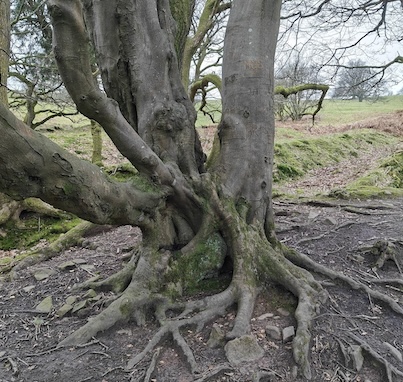
After many hours of placing pixels this became:
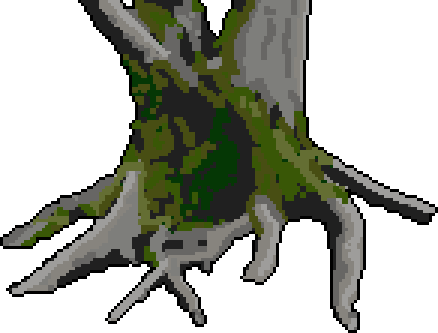
Which ended up being far too big. Currently this tree in game looks like:
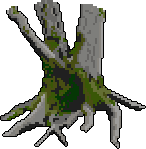
This technique of going directly from a reference photo to a sprite definitely helped get me off the ground. I think having some stand-out objects that are more detailed gives some depth to the world, and can be used to indicate to the player that there is something special about this object that might require investigation. But it is not a sustainable practice for a game that will probably have hundreds, maybe thousands of objects in world that need to have pixel art. I also needed generic, stylised trees and other artwork that could fill the world while not making it look busy. That required me to actually develop my own style, to create the pixel art without directly pulling from an image.
To aid me in evolving my own art style, I have found Google and Reddit to be my friends. There is a glut of amazing inspiration to be found just by Googling "x pixel art", or going to r/PixelArt. I am so grateful to other artists being so unabashed as to make their work free and accessible for others to take inspiration from. I have also found the world of 3D voxel art to be a great source for learning about colour palettes and translating the lumps and bumps of the real world into blocks, and so stumbling across Minecraft Youtubers such as Mogswamp and shovel241 has also lent a hand. Also it shouldn't go without saying that my admiration for other pixel art games is very influential on my design choices.
I was quite proud of my first solo tree:

But ultimately it was a little too small (I still find judging how large the artwork should be difficult), and it was too "front-on". My current iteration, that I really do like, has the same core DNA of the original but feels more cosy:
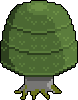
Finally, no game is complete without a playable character. My little guy was the first thing I worked on without any reference whatsoever, and I am perfectly happy saying that the first iteration was just bad and didn't fit into my vision for the game, both literally and figuratively. But just to double-down on my commitment to documenting the process, here is the first version of Hen alongside his much cuter and fitting counterpart:
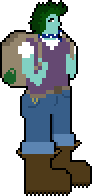

I do miss the mug on his pack though (but why his boot so big).
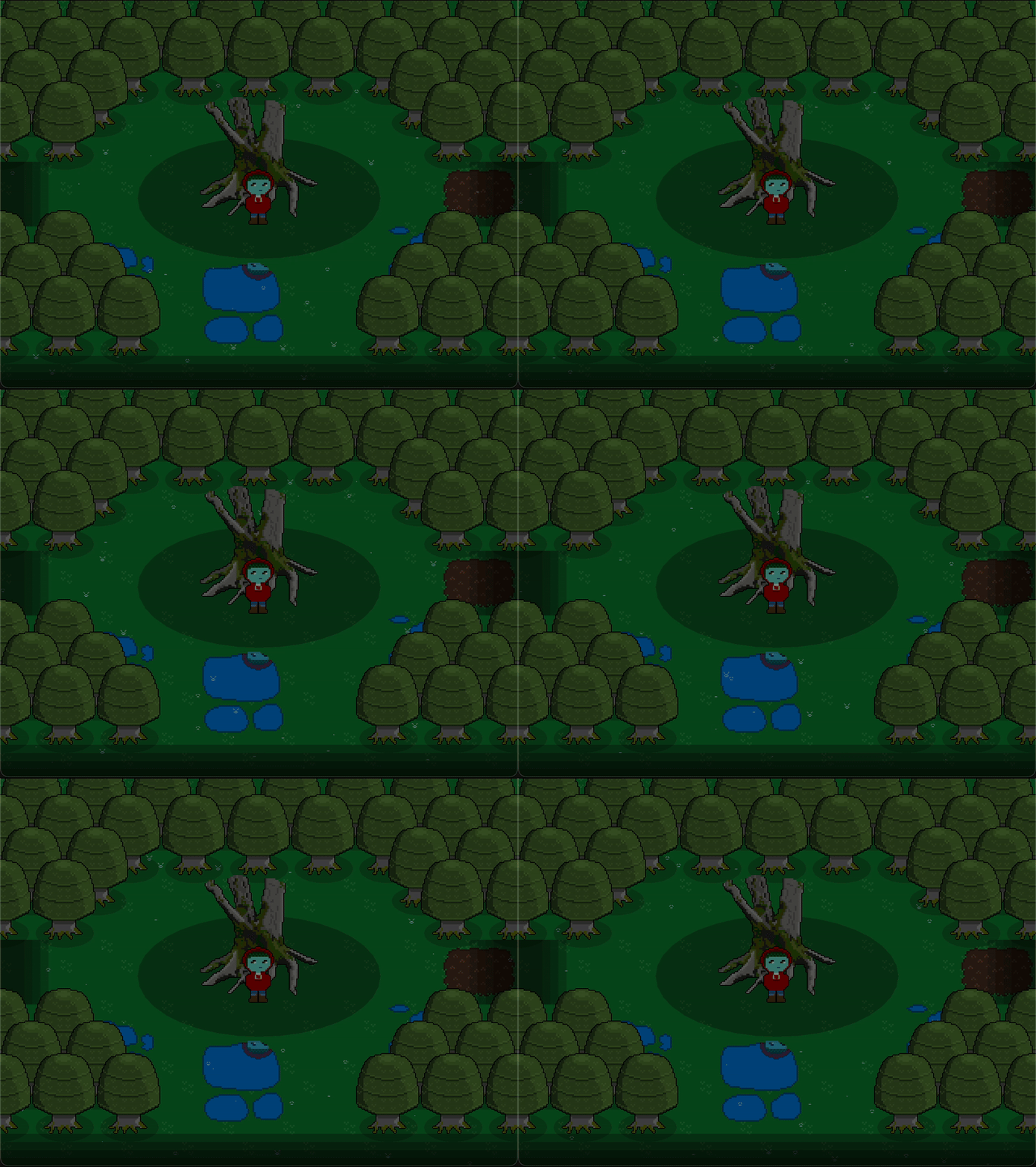
There is much more that can be shared and said - I haven't even touched on making things move, story-telling, or puzzle design - but for now I will end things with a preview of how everything has tied together into what I think is becoming a richer and richer game-world.
The game opens with the player waiting under a tree for the rain to pass, only for him to realise that sometimes you just have to put your head down and power on:
-
I mentioned in passing in a previous post that I did a lot of theatre as a teenager, which feels at odds with my current notion that I shy away from the arts on the grounds of subjective judgement. My reaction to this apparent contradiction is mainly two-fold - I was actually quite a naturally good actor (and people told me I was good, which helped), and there was something of an evaporation of self when I stepped on stage as a character. There could also be the fact that theatre is an ensemble piece; less of myself was the focus, and I didn't write or direct the plays. Writing and performing a one-man play fills me with the same dread as producing visual art. ↩
-
read "hours of therapy" after my mental health went in the bin. It was hard work and did not come in the blink of an eye. ↩
-
This pun doesn't work as well when it's a digital watch. ↩
-
I still tracked the run on Strava, obviously. ↩
-
wikipedia.org/wiki/sprite for those learning the lingo. ↩