It is daunting to share your creations with other people. Even more so when its a skill you've recently picked up. As a novice game developer, the need for feedback is unavoidably and obviously essential - not only as a way to better my craft, but also to partake in the human connection that art fosters. It is both nerve-wracking and exciting to watch my friends play through the first stages of my game, but these play-testing sessions have been amazing resources to push the design and allow me to explore more of this creative space.
In my limited experience, play-testing has three key benefits:
- Identify any coding or visual bugs. Video games are a software product like any other!
- Discover what people find fun and engaging, and what they do not.
- Exploring the intention gap between the developer and the player.
That term, "intention gap", may be unfamiliar to most readers - mainly because, as far as I know, I made it up1. Here is my definition:
The intention gap is the difference between what the developer intends the player to do at any given point in the game, and what the player actually tries to do.
Let's talk a bit more about why I've come to realise that this is such a relevant and important concept for me to consider in my development journey.
Tuning the intention gap
I've always enjoyed games that involve puzzle-solving and exploration - games with these elements rely strongly on an intention gap in order to build intrigue and encourage an explorative style of gameplay. In these types of game, not knowing exactly what you're supposed to be doing is part of the fun - it would be like picking up a crossword puzzle and having all the solutions written out for you next to the clues. That is to say, if the intention gap is too low, too much of the time, these games wouldn't be as enjoyable.
Of course its not as simple as "low intention gap = low fun" across the whole gaming landscape. Rhythm games, fighting games, visual novels, strategy games, are all genres where the intention gap is virtually zero - its incredibly clear at every point what the way to progress is in any given moment, even if it is beyond your skill level2. However in these games the enjoyment comes from other avenues, testing your skill against yourself or others, or simply enjoying a well-told story.
At the other end of the spectrum, there is a point at which too high an intention gap can become problematic, particularly in adventure games. Players wandering around aimlessly because they can't figure out the right way to go, or the right thing to click on, or the correct sequence of obscure operations to perform to solve a puzzle, won't have a good time, and won't come back for more. Design elements that are ubiquitous in adventure games exist precisely to counter this issue, such as using markers to indicate points of interest to interact with:
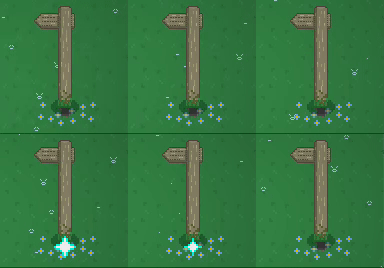
or having a pop-up when the player is nearby something that can be examined, and textual hints nudging the players attention:
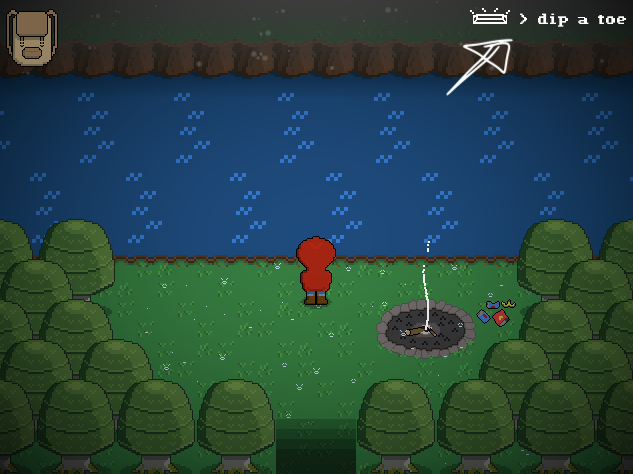
As for my game, hiraeth, it will be a game involving exploration, forking paths, and solving puzzles. So clearly I need to avoid having flashing signs saying "THIS WAY, IGNORE THAT OVER THERE" at every step of the way. At the game's macro level there is a true path, or story, that I want the player to go on, but I don't want to put up guardrails that prevent the player from looking into nooks and crannies or doing things slightly out of sequence. At the micro level of individual puzzles, I want a there to be a range of intention gaps - I don't want the solutions to puzzles to be so obvious that they are no fun, but likewise I don't want clues or solutions to be so obfuscated that the player bangs their head against the wall and gives up, unsatisfied and frustrated.
Finding that sweet spot - a goldilocks zone of just the right width of intention gap - has proved to be the hardest aspect of game design that I have encountered so far. As the developer, a big part of my process involves swapping between coding and running the game, and I can naturally test the game mechanics - movement, interactions, visuals, and so on - and get a sense for what is enjoyable gameplay. But it is another challenge entirely to correctly tune the intention gap just by myself, due mainly to the fact that I already know what you are supposed to do. I already have all the answers - the intention gap between me and me is a flat zero. This means it is so much harder to tell whether I have left enough clues to point a blank-slate player in the right direction without taking away their agency, or created a sequence of correct interactions that is frustratingly difficult to figure out on a first pass3.
This really is all just to say that sharing my project with other people is crucial to my development journey. So let's have a look at a couple of instances that have already been influenced by getting to watch people playing the opening scenes of hiraeth, and that helped me recognise the importance of thinking about intention gaps.
Down the frog hole
This is one of the first places you come to in the game, a simple fork in the path:
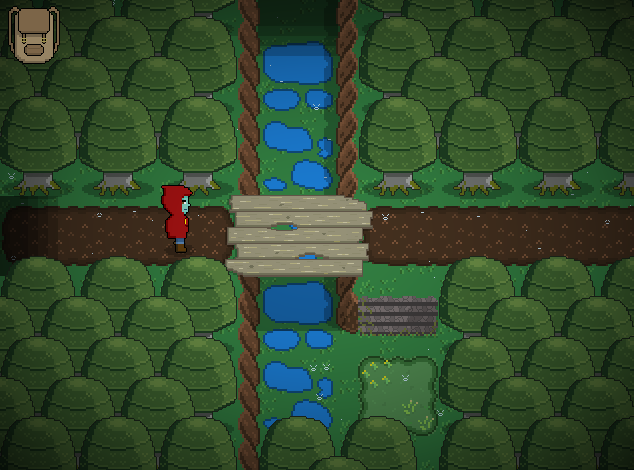
The intended way to progress the story is to first travel to the east, then backtrack and explore the path heading under the bridge and to the north. But it turned out the majority of players felt an urge to take the northern path before heading east. The two main pieces of feedback I gathered were:
- Going under the bridge just felt far more enticing, and
- because you enter from the left, the right most path feels like the end goal, and so it seemed more natural to traverse everything from left to right, meaning going north first.
Now, nothing breaks if you choose to visit the northern room first, but it does make the flow of this prologue section of the game feel slightly off. I don't want to downright stop the player from choosing to explore before proceeding to the east, but short of completely redrawing this area to fit how people were approaching it, I needed some sort of counter-measure to tempt folks into following the intended path (without taking away their agency). So I drew this little guy:
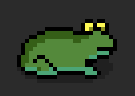
and named him Gorbo. Gorbo the Frog acts like Alice's rabbit, and people tend to want to follow him down the rabbit hole over anything else:
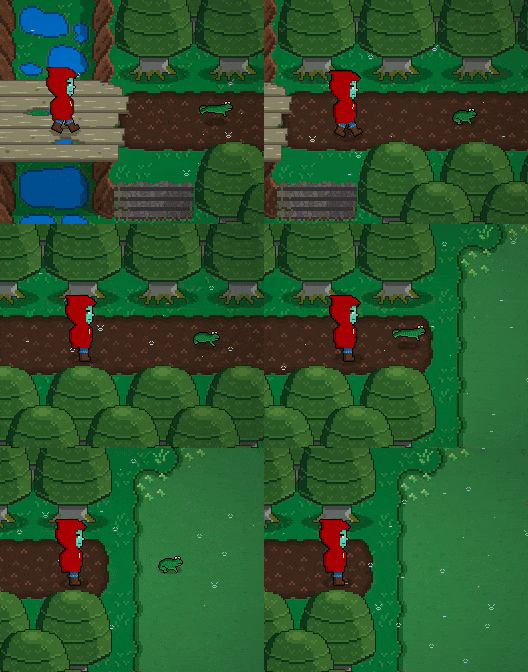
More people were drawn by the temptation of a froggy friend, and were hence pulled to the intended sequence. In summary, I had recognised that the intention gap was impeding players from enjoying the story in the way that makes the most sense, and found a way to shrink the gap while adding a bit more character and life to this area. That's all good stuff in my book. Maybe Gorbo will make some later appearances...
Sliding into one last stop
Of course, this isn't the only instance of trying to bridge too wide an intention gap (and certainly won't be the last). As mentioned, I want this game to involve solving puzzles, and during the development of my first I've also hit this obstacle. This first puzzle is a classic sliding tile puzzle, where the goal is to move tiles within a grid to create a picture (don't worry, no solution spoilers here!):
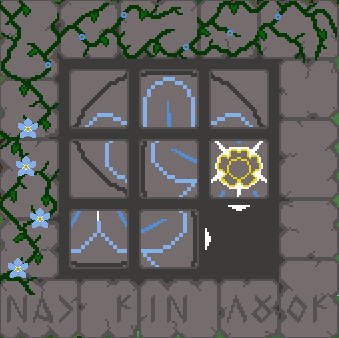
This is early in the game, so I didn't want it to be too difficult to solve. I chose the smallest possible size for such a puzzle, 3x3, and set the initial state of the puzzle so that its only ever 6 or so moves from the solution4. I am aware though that not every one will have actually played with such a puzzle before, and didn't want this to potentially filter players out early on in the game if they happened to get stuck. To mitigate this, I included those flowers you see around the puzzles border - these are actually an indicator of how far away from the solution you are, and will bloom and wilt as you move the tiles. This seemed like a really neat way to help players out and level the playing field. Except that players would instantly lock in on moving the tiles and trying to solve the puzzle without ever noticing the flowers moving around them. They would sometimes get stuck, ending up more and more scrambled. Not ideal.
To try and resolve this, I added some clues to point the player towards this "shortcut" - to make my intentions more clear to the player. On opening the puzzle, this animation plays, indicating (hopefully) that the objective is also to make all the flowers bloom:
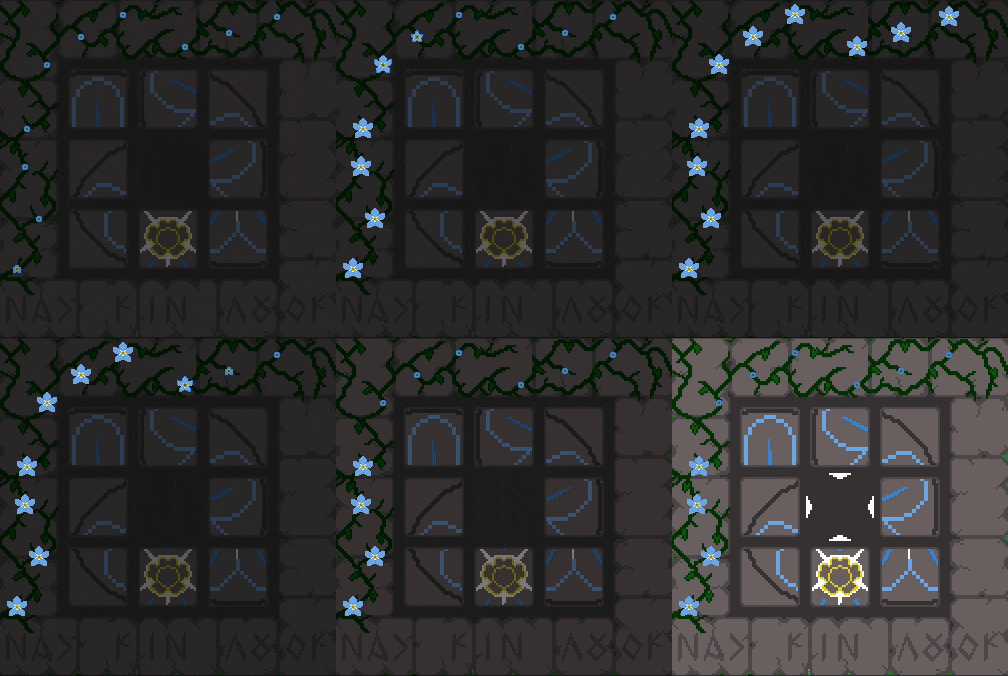
I also added some character dialogue that displays if the player causes too many flowers to wilt, suggesting that maybe they have something to with the solve. To my disappointment, folks still tended to hurl themselves headlong into the solving and often didn't make any connection between the movement of the tiles and the movement of the flowers. The intention gap is possibly too large in this case, and my efforts to ford the gap aren't always as effective as I presume they will be. On the bright side, there is a lesson even in that.
One thought that remains in this particular instance is that visuals alone might not be enough. I haven't even began the arduous journey into sound design (though I am excited to dip my toes into another unfamiliar territory!). I suspect in this example, something like a rising melody when the flowers bloom, and a countering falling melody when they wilt will really cement the connection I want the player to make. But that will be a story for another time.
Wrapping up
What I constantly realise while working on this project is just how multifaceted the task of game design is, and the immense skill that must go into mastering this craft. I am certain that the intention gap is already well-understood by many game developers (though probably called something else), and figuring out how to properly tune it is ultimately going to be a continual challenge as I take on this project. But that is what this is all about - throwing myself into this medium and seeing what shakes out. I better get back to coding.
-
Having no formal (or informal, really) training in game design, there are probably a lot of things I think about that other, more qualified people have spent a great length of time thinking about. But part of the fun of taking on this project somewhat blind is making these realisations for myself. ↩
-
Some games we might even think about as having a "negative" intention gap - sandboxes like Minecraft barely have any sense of progress or story laid out by the developers. Instead it is up to the player to create their own journey in the world they've been given, which is probably the purest form of play. ↩
-
Not to mention that I have to consider the players learning curve as they progress through the game - at the beginning I might want more guardrails to introduce them to the world and not put them off playing any further, and later give them more open-ended-ness and freedom. ↩
-
To do this we start the puzzle in its solved state and perform a random walk to a scrambled state. ↩
long live gorbo